
Rich with Evocative Detail

A year or two ago one of my children handed me a post it note with a quote on it. “The best writing isn’t determined by what happens, but rather by word choice.” I have no idea who said it or where she found it, but it’s been on my writing wall ever since because it expresses a profound truth. Word choice is everything when writing, especially when it comes to the minute details that flesh out a story.

Just think about one of your favorite books and the emotions that it elicited. Perhaps it made you cry or laugh. Maybe parts of it felt so real that you flinched. I’m thinking about the books that seize us and hold us enthralled as we become the characters. Their emotions, setbacks, and triumphs become our own as we devour the book. Our hearts break a little when we turn the last page and discover blank paper. Our souls, reluctant to accept an end of the written story, cry out that there must be more.

What is it about these books that hold us captive?

I heard the answer this week in a historical documentary podcast. One of the historians said a phrase that struck me. It’s been on repeat in my head: “rich with evocative details.”

The best writing is “rich with evocative details.” Those tiny snippets of information serve as a close up lens to focus us on both the emotion and the action within a story. Effective details are the portal to connection. They are the difference between telling a story and showing a story so well that it becomes an immersive experience. As a writer, that’s what I want for my readers.

Anyone can write a telling sentence. For example: Lauren leaned over the toilet and threw up.

Adding details to engage our senses provides an entirely different experience.

Wishing for death and past caring about lurking germs, Lauren gripped the edge of the cold toilet with white knuckles as another wave of nausea ripped through her stomach and convulsed her throat, but there was nothing left to expel beyond a few drops of sour yellow acid that disappeared after a negligible splash.

Poor Lauren sounds like she’s been through a wringer. Did you notice that I never mentioned throw up in the second sentence? I didn’t have to because you knew exactly what she was doing by the action. That’s the power of detail. It gives us an investment in the story. It provokes response. Who is Lauren? Why is she vomiting? How long has this been going on? Is she going to be alright?

Maybe this has been running through my mind because I’m in the process of editing Riley’s Bad Luck. There’s a quote from Robert Frost that I love. He said, “No tears in the writer, no tears in the reader. No surprise in the writer, no surprise in the reader.” I’m taking it to heart as I pore over my manuscript. It’s slow work, but rewarding. A few of the details I’ve added horrified me, which is great because the reader is supposed to be horrified at that moment.

On a broader note, imagine how rich our lives would be if we paid more attention to the evocative details around us. It’s the difference between living and existing. Go experience life and then write down the way it felt, tasted, smelled, looked, and sounded. You might amaze yourself.


2020 Writing Goals

It’s only taken me six days into the new year to finalize my 2020 goals. My goals are something I don’t like to make in a rush. Since I intend to accomplish them all, I spend as much time possible pondering what I’d like to achieve before making them official. Today is the day.

There are ten goals on my list. Some are personal. Some are professional. Some are spiritual. One is even physical. All are achievable. That’s an important aspect of goal making for me. Grandiose goals are well and good, but if they aren’t achievable then it’s a pure waste of time. I’ll never been an award winning choreographer. I don’t even know how to dance beyond the moves that are guaranteed to embarrass my kids. It would be sheer lunacy to set a 2020 goal to win the Tony Award for choreography. If I was interested in dancing, I could set a goal to take dance lessons. The Tony would have to be a lifelong goal, and even then, it’s not that great of a goal. I’d rather set my sights on choreographing a show and doing my best work.

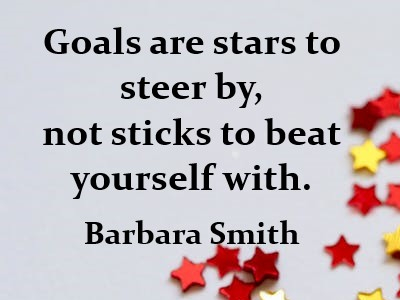
Barbara Smith quote

It’s not that I don’t believe in reaching for the stars. I do. One of my life ambitions is to have multiple novels published. It’s one of my overall goals, not one for any particular year. Instead I have related yearly goals. Learn more about the craft of writing. Write rough drafts. Do edits. Write second and third versions. Get critiques. More edits. Submit works. Those are the goals that will lead to being published. The plus side is that I’m being guided by my star without having to constantly beat myself up because I’m not published.

Like the Tony award example above, I don’t want to my books to be printed just so I can win awards. Don’t get me wrong, I’ll gladly accept tokens of achievement. My goal isn’t to be recognized for my writing, but rather to enrich someone’s life through a story I wrote. I’d rather help someone forget their troubles for a few hours than win a reward. I’d rather someone felt encouraged to keep trying after reading one of my books. Those are the real awards, and they don’t require dusting.

2020 writing goals

These are my official goals. Super achievable, and yet they will keep me focused on my end goal of being published.

Goal One: I currently have five or six books on my shelf about writing that I haven’t read. I can wimp out and read the three shortest ones. I can read the two longest and a short. It doesn’t matter as long as I read them. If I only get two read, well, it’s two more than I had read on January 1st.

Goal Two: Submitting Riley’s Bad Luck shouldn’t take too much. I’ve already prepared most of the documents required. I need to rework the beginning a wee bit and do a final edit to check for anything I might have missed. Coincidentally, it’s the goal I’m going to tackle first.

Goal Three: Peter’s Story was my NaNoWriMo project. By the time I stopped typing before Christmas, I reached 41,000 words. Getting our house painted and Christmas put the brakes on that project, but I’m ready to jump back in. Minimum 19,000 words to go!

Goal Four: I finished a version of Kate’s story in 2017 or early 2018. A very kind friend, who writes, reluctantly told me that I needed to work on conflict. That set me off on my intensive study of how to write books. I learned a lot. I’m indebted to her. Anyway, after all my studying and continued writing, I finally figured out a much more compelling conflict for that story. I also discovered how much I love writing in first person present, so Kate’s story is getting a necessary make over. I’m excited for this project as well. Actually, excited might be an understatement. I have to be patient, because some of the action in Kate’s story hinges on what happens in Peter’s book. By the way, both are part of my Rock Creek Chronicles series.

Goal Five: Book reviews, short stories, and writing updates should make at least one post a month doable. Right?!? I’m not at all flinching or looking sideways with a grimace as I type. Okay, I was. This might be the writing goal that gets me. Still, no beating myself up. It’s a goal, not an ultimatum.

Those are my writing goals for the year. Last year I had four, and accomplished three. The only one I didn’t quite get done was finish Riley’s Bad Luck. It’s so close that I’m counting it as a win anyway.

What about you? Do you make goals for each year?

May 2020 be a year you discover joy in your journey and achieve personal and professional growth!